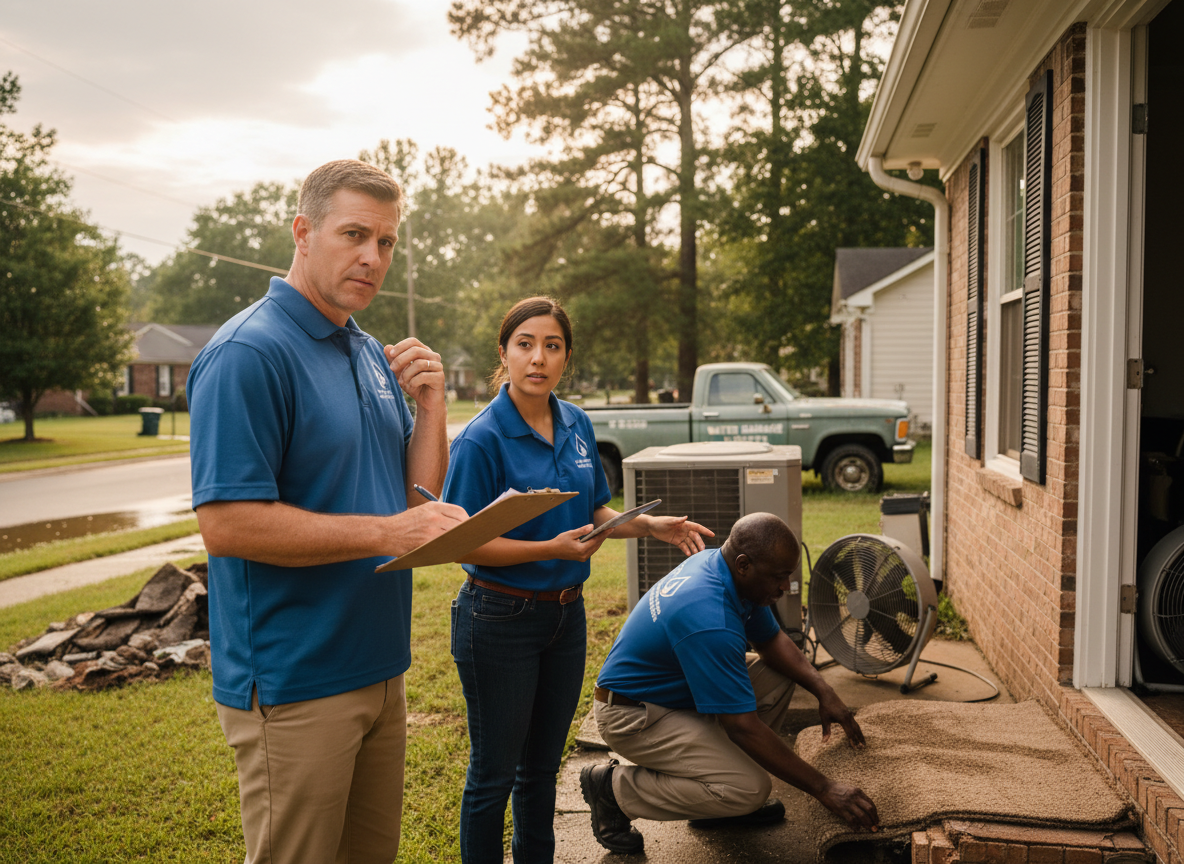
Churchland sits along the western edge of Chesapeake where older brick and frame homes from the 1960s and 1970s sit on smaller lots with limited side access. Heavy summer humidity and sudden downpours often push water toward low spots along Cedar Road and Victory Boulevard, sending moisture into crawl spaces and slab edges. Crews reach these streets quickly from the Great Bridge shop by taking I-664 to the Churchland exit, then working around school traffic at Churchland High School.
Many properties back up to drainage ditches that tie into the nearby Western Branch system. When those ditches back up after a storm, water enters finished basements through utility penetrations and older foundation seams. Restoration teams focus on pulling carpet and pad in the first hours, then place drying equipment in tight hallways common to these ranch layouts. Nearby landmarks like Churchland Park and the Churchland Square shopping area give clear reference points for mapping out equipment staging.
Access to rear yards is often blocked by fences and mature trees, so technicians carry lightweight dehumidifiers through side gates rather than driving equipment across lawns. This keeps disruption low for homeowners on narrow streets like Gum Road and Sterling Street.
Around Churchland
We regularly work near:
- 📍Churchland High School
- 📍Churchland Park
- 📍Cedar Road
- 📍Victory Boulevard
- 📍Churchland Square
- 📍Gum Road
Water Damage Restoration in Churchland — Local Notes
- •Churchland lots are narrow with mature landscaping that limits equipment trailers, so smaller portable units are staged inside garages or on driveways.
- •Many 1960s-1970s slabs sit close to drainage swales that feed into the Western Branch; after heavy rain these swales surcharge and force water under door thresholds.
- •Brick veneer homes with pier-and-beam sections require targeted drying under subfloors because vapor barriers are often missing or damaged.
- •School traffic around Churchland High School and Churchland Middle School slows daytime access, so evening and early morning arrivals keep response times under two hours.